
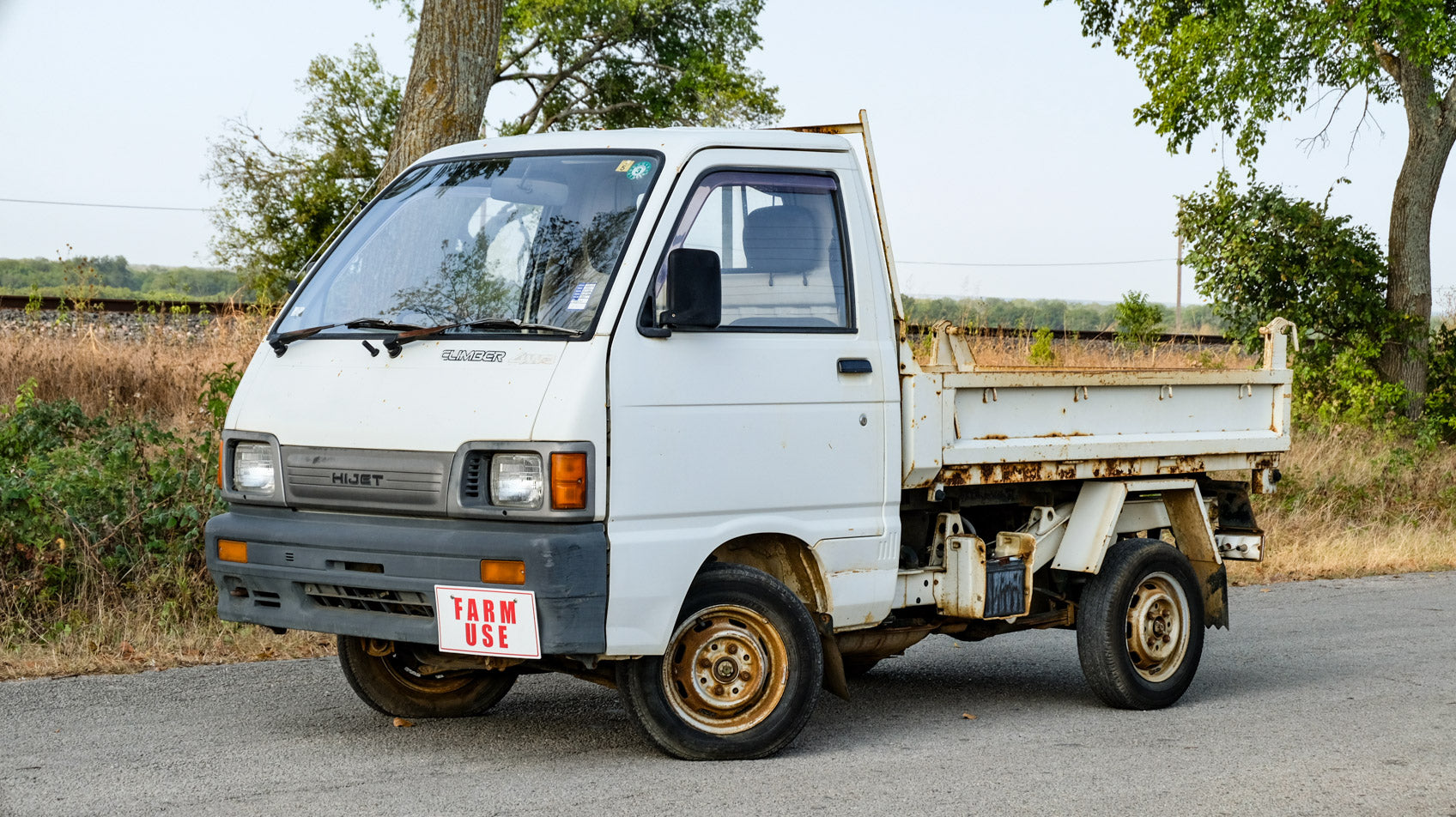
Born From a Tax Bracket, Not a Design Brief
The kei truck exists because of Japanese tax law, not because an engineer set out to build a cult classic. Japan’s “kei” (light vehicle) category dates to 1949, created to get affordable, practical vehicles onto the road during postwar reconstruction. The category came with strict size and engine limits — today capped at 660cc and roughly 11.2 feet long — in exchange for lower taxes, cheaper insurance, and easier parking and registration requirements. Manufacturers didn’t fight the limits; they got creative inside them.
The Golden Era of the Kei Truck
By the 1970s and 80s, Suzuki, Daihatsu, Honda, Subaru, and Mitsubishi were all building dedicated kei trucks aimed squarely at farmers, tradespeople, and small business owners navigating Japan’s narrow rural roads and tight urban alleys. Subaru went its own way with a rear-engine layout on the Sambar; the rest converged on a cab-over front-engine design that maximized bed space within the tiny footprint. These trucks became the backbone of Japanese agriculture — a role US pickups never quite filled for small-scale, tight-space work.
Why They’re Only Now Reaching the US in Numbers
US import law allows any vehicle 25 years or older to be imported and registered without meeting modern crash and emissions standards. Since kei trucks have been in continuous production since the 1960s, there’s a rolling supply of newly-25-year-eligible trucks every year — which is exactly why a 1999 model becomes importable in 2024, a 2000 model in 2025, and so on. That steady eligibility window, combined with Japan’s strict domestic inspection (shaken) system that keeps used vehicles in excellent mechanical shape, is why the US market for these trucks has grown so quickly over the last decade.
From Farm Tool to American Property Vehicle
What started as Japanese farm equipment has found an enthusiastic second life on American farms, ranches, hunting leases, and small properties — for many of the same reasons it succeeded in Japan: tight turning radius, low running costs, real 4WD capability, and a bed that’s genuinely useful without the bulk of a full-size pickup. See our breakdown of why farmers are switching from ATVs for more on that shift.
Frequently Asked Questions
How old does a kei truck have to be to import to the US?
25 years or older from its manufacture date, under the federal import exemption. See our import guide for the full process.
Why is the engine limited to 660cc?
That’s the current kei-class displacement limit set by Japanese regulation — it’s been raised over the decades (from 360cc originally) but has stayed at 660cc since 1990.
Are older kei trucks less reliable than newer ones?
Not particularly — Japan’s shaken inspection system keeps vehicles well maintained throughout their life in Japan, so a well-graded 1990s truck is often mechanically sound.
Which brand made the first kei truck?
Several manufacturers built kei-class trucks from the category’s early years; Suzuki, Daihatsu, Honda, Subaru, and Mitsubishi all had dedicated kei truck lines by the 1970s.
See how the major models stack up today in our five-way kei truck comparison, or browse current inventory.